
The Complete Guide to BJJ Gym Management
Running a BJJ academy demands scalable systems. Complete guide from daily operations to long-term growth strategies.
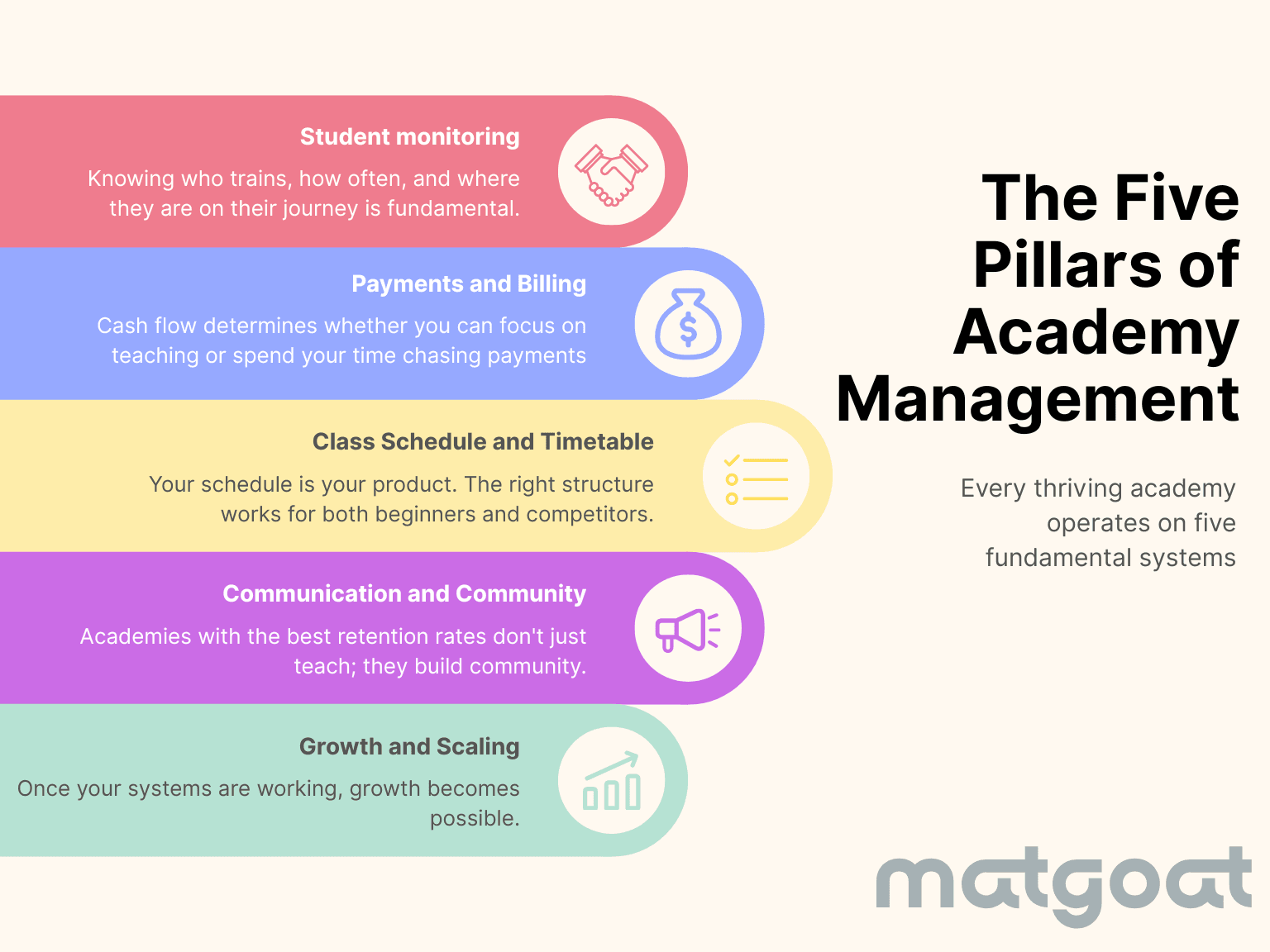
Running a successful BJJ academy requires mastering several interconnected systems: student tracking, payments, class scheduling, communication, and growth. This guide points you toward the right resources for each area.
The Five Pillars of Academy Management
Every thriving academy operates on five fundamental systems. A weakness in any of them creates friction that limits your growth.
1. Student Tracking and Belt Progression
Knowing who trains, how often, and where they are on their journey is fundamental. Without tracking, promotions become subjective and at-risk students slip through the cracks unnoticed.
Key challenges:
- Recording attendance across multiple programs (kids, adults, competition).
- Establishing objective and transparent promotion criteria.
- Managing stripe progression at scale.
→ Complete Guide to BJJ Student Tracking
Start with our free Student Tracking Template if you need a quick solution today.
2. Payments and Billing
Cash flow determines whether you can focus on teaching or spend your time chasing payments. Automated billing eliminates awkward conversations and reduces churn from declined cards.
Things to solve:
- Reducing failed payment rates.
- Handling past-due accounts professionally.
- Structuring pricing coherently and profitably.
→ Complete Guide to BJJ Academy Payments
3. Class Scheduling and Operations
Your schedule is your product. The right structure serves beginners and competitors, kids and adults, without burning out your instructors.
Key challenges:
- Balancing program diversity with mat availability.
- Managing instructor assignments and substitutions.
- Optimizing schedules to maximize attendance.
→ Complete Guide to BJJ Class Scheduling
Try our free Class Schedule Generator to draft your ideal weekly schedule.
4. Communication and Community
The academies with the best retention don’t just teach—they build community. Consistent communication keeps students engaged between sessions.
Key challenges:
- Re-engaging inactive students before they quit.
- Communicating effectively with parents in kids programs.
- Building culture through digital touchpoints.
→ Complete Guide to BJJ Academy Communication
5. Growth and Scaling
Once your systems work, growth becomes possible. But scaling without systems creates chaos.
Key challenges:
- Hiring and training instructors.
- Adding programs without diluting quality.
- Opening additional locations.
→ Complete Guide to Scaling Your BJJ Academy (coming soon)
Choosing the Right Software
The right management software connects all five pillars. Generic fitness software forces workarounds for BJJ-specific needs like belt tracking and technique libraries.
→ BJJ Academy Software Comparison (coming soon)
Where to Start
New academy owners: Start with student tracking—it’s the foundation everything else builds on.
Established but disorganized academies: Start with payments—fixing cash flow creates space and energy for other improvements.
Ready to grow: Go straight to scaling your academy—but only after your core systems are solid.
This guide is part of MatGoat’s Academy Management Series. As we publish each specialized guide, the links above will become active.

BJJ practitioner, blue belt, always eager to keep learning and improving. Software engineer for over 15 years, I founded MatGoat to help BJJ and MMA academies continue growing.