
Class Scheduling for BJJ Academies: Complete Guide
Your schedule is your product. This guide covers how to structure classes for different levels, manage instructors, and optimize mat occupancy.
Your schedule is your product. A well-designed schedule serves beginners and advanced students, kids and adults, competitors and hobbyists—without burning out your instructors or wasting mat space.
This guide covers everything you need to create a schedule that maximizes attendance, retention, and revenue.
Table of Contents
- Why Scheduling Matters More Than You Think
- Anatomy of an Effective Schedule
- Structuring Classes by Level
- Special Programs: Kids, Competition, No-Gi
- Instructor Management
- Optimizing Mat Occupancy
- Open Mats and Special Classes
- Scheduling Software
Why Scheduling Matters More Than You Think
Many academy owners create their schedule once and don’t touch it for years. This is a costly mistake.
The Direct Impact on Your Business
On retention:
A student who can’t find classes compatible with their schedule quits. Not because they don’t like BJJ, but because they can’t train.
Schedule incompatibility is a useful cancellation category to track. Test early-morning and weekend classes against demand in your own academy instead of assuming a universal retention uplift.
On revenue:
Every empty time slot is money you’re not making. Every overcrowded class is potential you’re not capturing.
An additional peak-hour class can create capacity for new memberships, while an overcrowded class can reduce individual attention. Model the financial impact with your own prices, capacity, attendance, and retention data.
On instructors:
A poorly designed schedule burns out your instructors. Classes with no time between them, fragmented schedules, and lack of rest lead to exhaustion.
The Three Key Questions
Before designing or modifying your schedule, try to think about:
- Who are your students? Office professionals, students, parents, shift workers, law enforcement…
- What do they want to train? Fundamentals, competition, no-gi, self-defense…
- When can they train? Mornings, midday, afternoons, evenings, weekends…
The answers determine everything else.
Anatomy of an Effective Schedule
There’s no universal perfect schedule. But there are principles that work for most academies.
Time Slots and Their Profiles
Early morning (6:00-8:00 AM)
- Profile: Professionals before work, parents before taking kids to school.
- Characteristics: High consistency, low turnover, value punctuality.
- Class type: Technique + drilling. Little extended sparring (they have to go to work).
- Typical occupancy: 8-15 people.
Mid-morning (9:00 AM-12:00 PM)
- Profile: Remote workers, freelancers, retirees, stay-at-home parents.
- Characteristics: Smaller but very loyal group.
- Class type: Full technique + sparring.
- Typical occupancy: 5-12 people.
Midday (12:00-2:00 PM)
- Profile: Professionals on lunch break, college students.
- Characteristics: Limited time (60 min max), need to shower and return.
- Class type: Intensive, less warm-up, direct technique.
- Typical occupancy: 8-20 people.
Early afternoon (4:00-6:00 PM)
- Profile: Kids after school, students, workers with flexible hours.
- Characteristics: Transition between programs (kids → adults).
- Class type: Mainly children’s classes.
- Typical occupancy: Variable depending on program.
Evening (6:00-10:00 PM)
- Profile: Majority of adults with office jobs.
- Characteristics: Maximum demand, maximum competition for space.
- Class type: All types—fundamentals, advanced, competition, no-gi.
- Typical occupancy: 15-30+ people.
Weekend
- Profile: Everyone who can’t make it during the week + families.
- Characteristics: More relaxed, better for seminars and events.
- Class type: Open mat, special classes, competition.
- Typical occupancy: Variable.
Standard Class Structure
A typical 60-90 minute class:
| Block | Duration | Content |
|---|---|---|
| Warm-up | 10-15 min | Mobility, BJJ-specific movements |
| Technique | 25-35 min | Demonstration + partner practice |
| Drilling | 10-15 min | Repetition of the day’s technique |
| Sparring | 15-25 min | 5-6 minute rolls |
| Closing | 5 min | Questions, announcements, bow out |
Variations by class type:
- Fundamentals class: More time on technique, less or no free sparring.
- Advanced class: Shorter warm-up, more complex techniques, more sparring.
- Competition class: Intense sparring, situationals, physical conditioning.
- Midday class: Everything compressed to 45-60 min.
Structuring Classes by Level
One of the most important decisions: how do you separate (or not) students by level?
Option 1: Mixed Classes (Everyone Together)
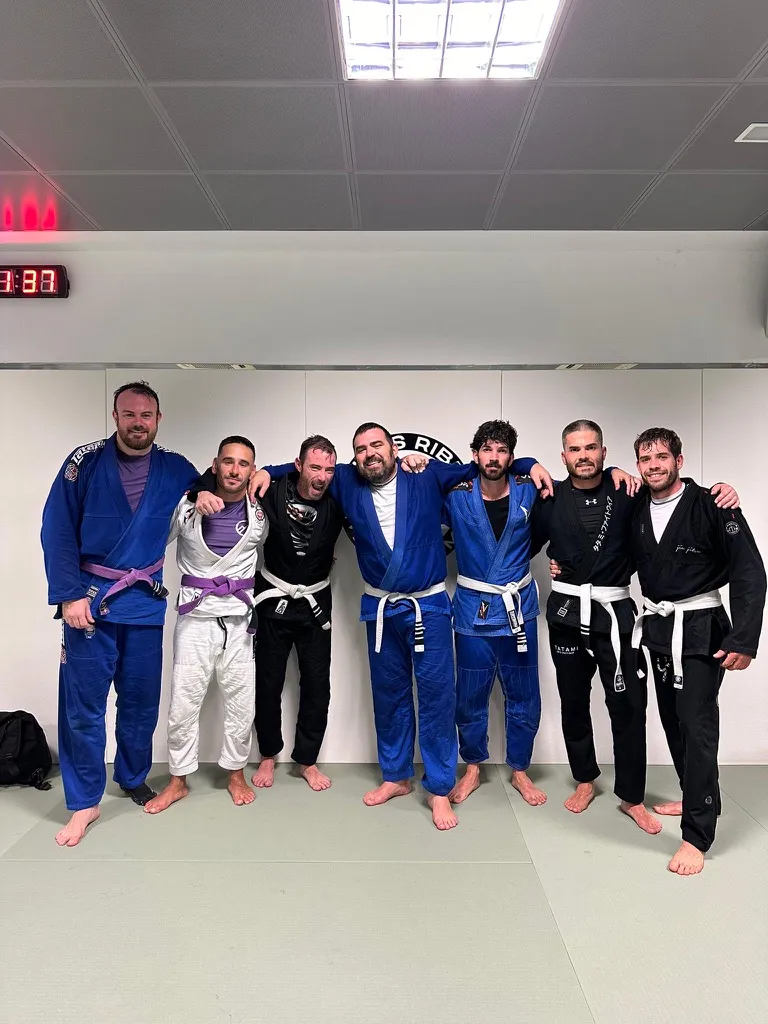
All levels train together in the same class.
Advantages:
- Maximum schedule flexibility for everyone.
- Beginners learn from advanced students.
- Easier to schedule (fewer classes needed).
- Builds community across levels.
Disadvantages:
- Difficult to adapt content to everyone.
- Beginners may feel lost.
- Advanced students may get bored with basic techniques.
- Higher injury risk in mixed sparring.
Best for: Small academies (fewer than 40 students) where dividing isn’t viable.
Option 2: Classes Separated by Level
Specific classes for beginners, intermediate, and advanced.
Typical structure:
- Fundamentals (0-12 months): Basic positions, escapes, fundamental submissions.
- Intermediate (1-3 years): More complex techniques, developing personal game.
- Advanced (3+ years): Refinement, advanced concepts, competition preparation.
Advantages:
- Content adapted to each level.
- Clearer progression for the student.
- Lower injury risk.
- Better experience for beginners.
Disadvantages:
- Requires more class hours (more instructor cost).
- Less schedule flexibility.
- Can create “silos” between levels.
- Students on the borderline between levels don’t know where to go.
Best for: Medium-large academies (60+ students) with enough volume to fill each level.
Option 3: Hybrid (Our Recommendation)
Separate fundamentals classes + “all levels” classes open to everyone.
Implementation example:
| Time | Monday | Tuesday | Wednesday | Thursday | Friday | Saturday |
|---|---|---|---|---|---|---|
| 7:00 AM | All levels | - | All levels | - | All levels | - |
| 12:00 PM | All levels | All levels | All levels | All levels | All levels | - |
| 7:00 PM | Fundamentals | All levels | Fundamentals | All levels | Open mat | - |
| 8:00 PM | All levels | Advanced | All levels | Competition | - | Open mat |
Why it works:
- Beginners have dedicated classes where they don’t get lost.
- Everyone has flexibility with “all levels” classes.
- Advanced students have space to go deeper.
- Competitors have specific training.
Criteria for Separating Levels
When can a student move from fundamentals to all levels?
Option A: By time
- After X months in fundamentals (typical: 6-12 months).
- Simple but arbitrary.
Option B: By belt
- Fundamentals: white belts.
- All levels: blue belts and up.
- Clear but can be slow.
Option C: By evaluation
- The instructor decides when the student is ready.
- More precise but subjective.
Option D: By attendance
- After X fundamentals classes (typical: 50-100 classes).
- Objective and data-based.
Our recommendation: combine belt + minimum attendance. For example: “1 stripe + 50 fundamentals classes.”
Special Programs
Beyond regular adult classes, most academies have specific programs.
Kids Program
A kids program can become a significant part of an academy’s membership and revenue. Its contribution depends on local demand, capacity, staffing, and pricing.
Age segmentation:
Sample starting point: These age bands, durations, and times are planning examples, not industry benchmarks. Adapt them to your students and safeguarding requirements.
| Group | Age | Duration | Focus |
|---|---|---|---|
| Little ones | 4-6 years | 30-45 min | Games, coordination, basic discipline |
| Kids | 7-12 years | 45-60 min | Fundamental technique, values, friendly competition |
| Teens | 13-17 years | 60 min | Similar to adults, preparation for transition |
Typical schedules:
- Weekdays: 5:00-6:00 PM (after school).
- Saturday: 10:00 AM-12:00 PM (classes + games).
- Avoid competing with school activities and popular extracurriculars.
Special considerations:
- Parents decide, not kids. Your marketing should speak to them.
- Flexibility in attendance: kids have many activities.
- Constant communication with parents about progress.
- Family events (graduations) increase retention.
Competition Program
Competitors have different needs: more intensity, more rolls, specific preparation.
Structure options:
Option A: Dedicated classes
- 2-3 weekly classes only for competitors.
- Specific game plan content.
- Intense sparring and situationals.
Option B: Additional training
- Competitors attend regular classes + extra sessions.
- Specific open mats with higher intensity.
- Additional drilling before/after classes.
Option C: Complete program
- Competitors train mainly among themselves.
- Individualized preparation plan.
- Nutrition, weight, and fitness tracking.
Economic consideration: If the competition program requires additional coaching or facilities, price it from those costs and local demand rather than applying a generic surcharge.
No-Gi / Grappling
Increasingly popular thanks to MMA and submission grappling influence.
Integration options:
- Specific days: Tuesdays and Thursdays are no-gi.
- Parallel classes: Gi and no-gi at the same time (requires more space).
- Alternation: Gi weeks, no-gi weeks.
- Add-on: No-gi as a separate program with additional cost.
Considerations:
- Some students only want no-gi (especially those coming from MMA).
- Others only want gi.
- Most benefit from training both.
- No-gi requires less equipment (good for free trials).
Instructor Management
Your instructors are the most important asset after yourself. A schedule that burns them out makes them leave.
Load Distribution
Recommended weekly maximums:
| Instructor type | Classes/week | Hours/week |
|---|---|---|
| Head instructor (you) | 10-15 | 15-20 |
| Full-time instructor | 15-20 | 20-25 |
| Part-time instructor | 5-10 | 5-12 |
| Volunteer/assistant instructor | 2-5 | 2-6 |
Signs of overload:
- Frequent late arrivals or cancellations.
- Class quality decreases.
- Less energy in classes.
- Student complaints about lack of attention.
- The instructor mentions being tired.
Team Structure
Small academy (1-50 students):
- You teach most classes.
- 1-2 assistants to cover absences.
- Assistants can be advanced purple/brown belts.
Medium academy (50-100 students):
- You + 1-2 hired instructors.
- Division by programs (you adults, another kids).
- Defined backup system.
Large academy (100+ students):
- Technical director (you or senior instructor).
- 2-4 specialized instructors.
- Assistants for each program.
- Schedule coordinator.
Instructor Compensation
Common models:
Per class:
- $20-50 per class (depending on experience and location).
- Simple to calculate.
- Incentivizes teaching more classes (beware of burnout).
Fixed salary:
- Fixed monthly amount for X committed classes.
- More stability for the instructor.
- More predictable for your budget.
Hybrid:
- Fixed base + bonus per additional class.
- Balances stability with flexibility.
Revenue share:
- Percentage of fees from their classes.
- Aligns incentives with growth.
- More complex to administer.
Absence Coverage
Inevitably, there will be absences. Have a plan:
- Substitute list: Instructors who can cover with little notice.
- Notice protocol: Minimum advance notice time.
- Communication: How students are notified of the change.
- Compensation: How the substitute is paid.
Golden rule: Never cancel a class if you can avoid it. A cancelled class hurts retention more than a class with a substitute.
Optimizing Mat Occupancy
The mat has limited capacity. Optimizing it is key to profitability.
Calculating Capacity
Basic formula:
Capacity = (Square meters of mat) ÷ (Space per student)Recommended space per student for comfort:
| Class type | sq ft per person |
|---|---|
| Technique/drilling | 40-65 sq ft |
| Rolling | 85-110 sq ft |
| Kids | 30-40 sq ft |
| Typical mixed class | 65-85 sq ft |
Free tool: Use our tatami capacity calculator to calculate how many students fit in your space by class type.
Boxing gyms need a different unit for the same decision. Capacity may follow the number of usable bags, safe ring or floor space, and the coach-to-member ratio. The boxing studio software guide shows how MatGoat connects that limit to pre-registration and completed attendance.
Signs of Capacity Problems
Under-occupancy (demand problem):
- Classes with fewer than 5 people regularly.
- Instructor costs not justified by attendance.
- Feeling of “empty academy.”
Solutions:
- Consolidate schedules (eliminate poorly attended classes).
- Move classes to more popular time slots.
- Specific marketing for those time slots.
- Offer incentives for off-peak hours.
Over-occupancy (capacity problem):
- Classes with waiting lists.
- Students colliding during sparring.
- Complaints about lack of space.
- Injuries from people bumping into each other.
Solutions:
- Add parallel classes at the same time (if there’s space).
- Split into two shifts (7:00 PM and 8:00 PM instead of just 7:30 PM).
- Limit enrollment per class (cap + waiting list).
- Incentivize less popular times with discounts.
Analyzing Attendance Data
If you have a check-in system, you have valuable data:
Metrics to review monthly:
| Metric | What it tells you |
|---|---|
| Average attendance per class | Which classes work? |
| Occupancy vs capacity | Where is there too much/little space? |
| Trend by day of the week | Which days are strongest? |
| Retention by time slot | Which times retain best? |
Data-based actions:
Illustrative examples: The figures below show how to reason from your own occupancy data; they are not benchmarks.
- If Monday 7 PM is at 120% and Tuesday 7 PM at 50%, incentivize Tuesday.
- If the 12 PM class has 4 consistent people, maybe worth keeping (high retention).
- If the Saturday class fluctuates a lot, make it bi-weekly instead of weekly.
Before adding more classes, compare occupancy with retention, revenue, and demand. The guide to growing your martial arts academy places these decisions within a broader plan.
Open Mats and Special Classes
Beyond the regular schedule, special events add value.
Open Mat
Open mat time for students to train freely.
Formats:
- Pure open mat: No instructor, students do free rolls.
- Guided open mat: Instructor present to supervise and answer questions.
- Themed open mat: Focus on an area (leg locks, passing, submissions).
When to schedule:
- Friday night (end of training week).
- Saturday/Sunday morning (when there are no regular classes).
- After regular classes (for those who want more sparring).
Considerations:
- Included in membership or additional cost?
- Open to visitors from other academies?
- Minimum level to participate? (safety)
Seminars and Workshops
Special events with guest instructors or specific focus.
Types:
- Guest seminar: Renowned instructor visits your academy.
- Technical workshop: Deep dive into a specific area (guards, passing, leg locks).
- Competition seminar: Preparation for specific tournament.
- Instructor workshop: Training for your team.
Logistics:
| Aspect | Consideration |
|---|---|
| Duration | 2-4 hours typical |
| Price | $40-100 per person |
| Size | Limit to comfortable capacity |
| Day | Saturday or Sunday |
| Promotion | 3-4 weeks in advance |
Recurring Special Classes
Ideas to add variety:
- Women’s class: Safe space for female beginners.
- Masters class (40+): Adapted pace, less impact.
- Drilling session: Only technical repetition, no sparring.
- Sparring only: For those who want more rounds.
- Positional sparring: Work from specific positions.
- Yoga/mobility for BJJ: Recovery complement.
Scheduling Software
Managing schedules manually works up to a point. After that, you need help.
BJJ academy management software such as MatGoat keeps schedules beside student check-in, attendance history, belt progress, and payment records. That connection makes schedule decisions easier to measure.
Academies that combine BJJ with wrestling, MMA, boxing, or other programs can review the broader martial arts management software workflow before comparing scheduling options.
Essential Features
| Feature | Why It Matters |
|---|---|
| Visual calendar | See the entire schedule at a glance |
| Instructor assignment | Know who teaches each class |
| Capacity limits | Avoid overcrowding |
| Student check-in | Real attendance data |
| Notifications | Automatically notify changes |
| Online booking | Students reserve their spot |
Advanced Features
| Feature | Benefit |
|---|---|
| Automatic waitlist | Capture unserved demand |
| Cancellation with penalty | Reduce no-shows |
| Occupancy reports | Data to optimize |
| Payment integration | Charge for premium classes |
| Mobile app | Students see schedule on phone |
Software Options
Martial arts specialized software like MatGoat:
- Designed for BJJ/MMA academies.
- Understands concepts like belts, programs, etc.
- Integration with other functions (payments, tracking).
Generic fitness software:
- More options in the market.
- May require adaptations.
- Sometimes cheaper.
DIY solution (Google Calendar + Sheets):
- Free.
- Flexible.
- Doesn’t scale well.
- No advanced features.
Our recommendation: For academies with more than 50 students, specialized software pays for itself in time saved and data obtained.
Implementing Schedule Changes
If You’re Starting from Scratch
Week 1-2: Research
- Survey potential students about preferred schedules.
- Analyze local competition (what schedules do they offer?).
- Define your limitations (space, instructors, your availability).
Week 3: Design
- Create schedule draft based on data. Our free Class Schedule Generator can help you draft and visualize your schedule before committing to it.
- Validate instructor availability.
- Define capacities per class.
Week 4: Launch
- Publish schedule on all channels.
- Clearly communicate which class is for whom.
- Prepare to adjust based on actual response.
If You Already Have an Established Schedule
Step 1: Audit current situation
- Which classes are full? Which are empty?
- Where are there student complaints?
- Are your instructors burned out?
Step 2: Identify necessary changes
- Prioritize by impact (more students affected = more important).
- Start with small changes.
- Avoid revolutionizing everything at once.
Step 3: Communicate in advance
- Minimum 2 weeks notice for major changes.
- Explain why the change is happening.
- Offer alternatives to those affected.
Step 4: Monitor results
- Compare attendance before/after.
- Actively collect feedback.
- Adjust if necessary.
Common Mistakes to Avoid
Changing schedules without notice
- Undermines trust and student routines.
Adding classes without demonstrated demand
- Instructor cost without ROI.
Eliminating poorly attended classes without analysis
- Those 4 students in the 7 AM class may be very loyal and valuable.
Not considering the student’s perspective
- “It works for me” doesn’t mean it works for them.
Copying another academy’s schedule
- Their students are not your students.
Related Resources
- Instructor Management: Compensation and Development (coming soon)
- BJJ for Kids: How to Structure a Program Parents Love
- Capacity Optimization: Case Studies (coming soon)
- Complete Guide to BJJ Academy Management
- Student Tracking Guide
- Payments and Billing Guide
This guide is part of the MatGoat Academy Management Series. For more resources on how to run a successful BJJ academy, explore our other guides.

Founder of MatGoat and a software engineer with more than 20 years of experience building software products. He has practiced BJJ since 2021 and develops MatGoat using feedback from martial arts academies.
View full profile