
IBJJF Illegal Moves by Belt and Age
Check which techniques the IBJJF prohibits by age, belt, and format, with guidance on leg locks, jumping guard, and knee reaping.
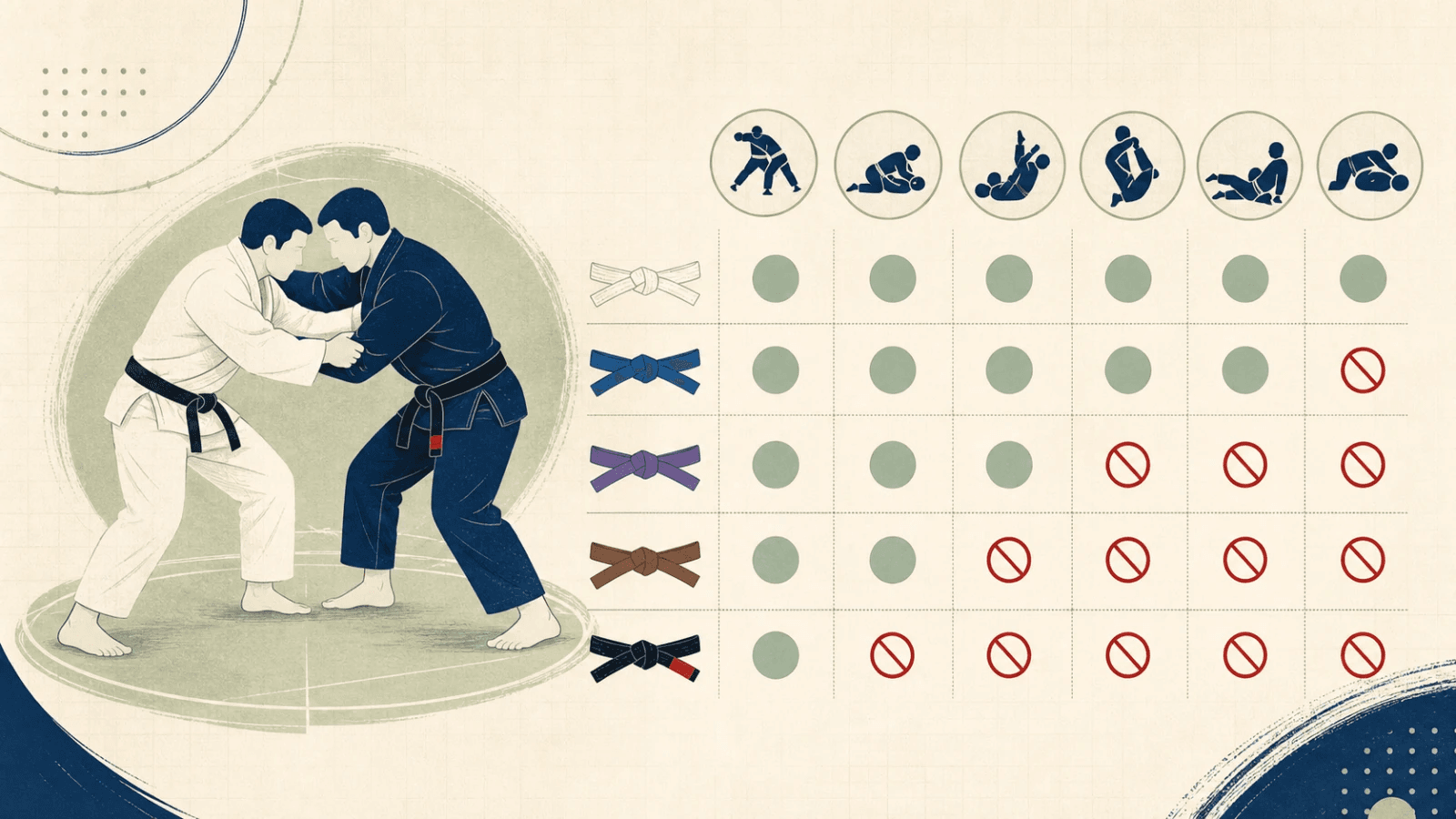
The IBJJF does not apply one list of illegal moves to every competitor. A prohibition depends on age, belt, and, in one specific case, whether an adult brown or black belt match is gi or no-gi. The official June 2024 matrix contains 26 technical situations across six category columns.
At the most restrictive end, all 26 rows are marked for athletes aged 4 through 12. At the other end, the adult brown and black belt no-gi category retains the final six marked rows. The list contracts in stages between those groups.
The explorer turns that matrix into a practical lookup. Select an age, belt, and format to see which rows the source marks as prohibited for that category.
2026, version 6.0
Explore techniques listed as prohibited
Choose one of the six poster categories, then search or filter its 26 techniques.
A red marker means the IBJJF manual lists the technique as prohibited for the selected category.
No red marker means only that the manual does not list the technique as prohibited in that category. It is not unconditional permission.
-
Submission techniques that stretch the legs apart
Listed as prohibited
Not listed as prohibited for this category
Official IBJJF illustration (demonstration only) p. 30 -
Choke with a spinal lock
Listed as prohibited
Not listed as prohibited for this category
Official IBJJF illustration (demonstration only) p. 30 -
Straight foot lock
Listed as prohibited
Not listed as prohibited for this category
Official IBJJF illustration (demonstration only) p. 30 -
Forearm choke using the sleeve (Ezequiel choke)
Listed as prohibited
Not listed as prohibited for this category
Official IBJJF illustration (demonstration only) p. 30 -
Frontal guillotine choke
Listed as prohibited
Not listed as prohibited for this category
Official IBJJF illustration (demonstration only) p. 30 -
Omoplata
Listed as prohibited
Not listed as prohibited for this category
Official IBJJF illustration (demonstration only) p. 30 -
Triangle while pulling the head
Listed as prohibited
Not listed as prohibited for this category
Official IBJJF illustration (demonstration only) p. 30 -
Arm triangle
Listed as prohibited
Not listed as prohibited for this category
Official IBJJF illustration (demonstration only) p. 30 -
Closed-guard lock with the legs compressing the kidneys or ribs
Listed as prohibited
Not listed as prohibited for this category
Official IBJJF illustration (demonstration only) p. 30 -
Wrist lock
Listed as prohibited
Not listed as prohibited for this category
Official IBJJF illustration (demonstration only) p. 30 -
Single-leg takedown with the attacker’s head outside the opponent’s body
Listed as prohibited
Not listed as prohibited for this category
Official IBJJF illustration (demonstration only) p. 30Footnote: although this technique is listed as prohibited, the athlete is not penalized.
-
Bicep slicer
Listed as prohibited
Not listed as prohibited for this category
Official IBJJF illustration (demonstration only) p. 30 -
Calf slicer
Listed as prohibited
Not listed as prohibited for this category
Official IBJJF illustration (demonstration only) p. 30 -
Knee bar
Listed as prohibited
Not listed as prohibited for this category
Official IBJJF illustration (demonstration only) p. 30 -
Toe hold
Listed as prohibited
Not listed as prohibited for this category
Official IBJJF illustration (demonstration only) p. 31 -
In a straight foot lock, turning toward the foot that is not under attack
Listed as prohibited
Not listed as prohibited for this category
Official IBJJF illustration (demonstration only) p. 31 -
Heel hook
Listed as prohibited
Not listed as prohibited for this category
Official IBJJF illustration (demonstration only) p. 31 -
Locks that twist the knees
Listed as prohibited
Not listed as prohibited for this category
Official IBJJF illustration (demonstration only) p. 31 -
Knee reaping
Listed as prohibited
Not listed as prohibited for this category
Photo: Rolling And The Punches / IBJJF (demonstration only) p. 32,33 -
In a toe hold, applying outward pressure on the foot
Listed as prohibited
Not listed as prohibited for this category
Official IBJJF illustration (demonstration only) p. 31 -
Slam
Listed as prohibited
Not listed as prohibited for this category
Official IBJJF illustration (demonstration only) p. 31 -
Spinal lock without a choke
Listed as prohibited
Not listed as prohibited for this category
Official IBJJF illustration (demonstration only) p. 31 -
Scissor takedown
Listed as prohibited
Not listed as prohibited for this category
Official IBJJF illustration (demonstration only) p. 31 -
Bending fingers backward
Listed as prohibited
Not listed as prohibited for this category
Official IBJJF illustration (demonstration only) p. 31 -
While defending a single-leg with the opponent’s head outside, gripping the belt and throwing the opponent onto the head
Listed as prohibited
Not listed as prohibited for this category
Official IBJJF illustration (demonstration only) p. 31 -
Suplex takedown that lands the opponent on the head or neck
Listed as prohibited
Not listed as prohibited for this category
Official IBJJF illustration (demonstration only) p. 29
No techniques match this search and filter.
How to use the explorer without overreading the matrix
Start with the division in which you will compete, not the technique you want to use. The IBJJF table groups several profiles that share a rules column:
- Athletes aged 16 and 17 at every belt share a column with white belts from Adult through Master 7.
- Blue and purple belts from Adult through Master 7 form another group.
- Brown and black belts from Adult through Master 7 share a column, except for the Adult no-gi division.
- Only Adult brown and black belts in no-gi move to the final column.
The last distinction prevents a common error. A master brown or black belt competing in no-gi remains in the preceding column. The sixth-column exception says Adult, not Adult through Master 7.
Read each explorer result as “this row is marked as prohibited for this category.” A blank cell does not provide blanket permission. A technique can still constitute another foul because of its execution, the position of the head or neck, a reaction that puts the opponent at risk, or an event-specific instruction.
The IBJJF also warns that the list images are examples. They do not represent every prohibited technical situation or variation. The referee applies the full rules text to the movement that occurs, not only the short label in a row.
The restriction staircase by age and belt
The matrix follows a clear progression. The numbers below refer to its 26 official rows:
| Matrix category | Rows marked as prohibited |
|---|---|
| Ages 4 through 12 | 1 through 26 |
| Ages 13 through 15 | 2 through 26 |
| Ages 16 and 17 at every belt, plus white belts from Adult through Master 7 | 9 through 26 |
| Blue and purple belts from Adult through Master 7 | 12 through 26 |
| Brown and black belts from Adult through Master 7, except Adult no-gi | 17 through 26 |
| Adult brown and black belts in no-gi | 21 through 26 |
This staircase makes the rules easier to study in blocks. For athletes aged 4 through 12, the list covers everything from submission techniques that stretch the legs apart and several chokes to every listed leg lock and the final six prohibitions. For athletes aged 13 through 15, the first row is no longer marked, but rows 2 through 26 remain prohibited.
For 16- and 17-year-olds, and for adult and master white belts, rows 1 through 8 are no longer marked. That block includes the straight ankle lock, Ezekiel choke, front guillotine, omoplata, triangle while pulling the head, and arm triangle. This describes the matrix. It does not replace technical instruction or remove other grounds for a penalty.
The next change occurs at adult blue belt. Rows 9 through 11 are no longer marked, including the wrist lock. Slicers, kneebars, toe holds, and specified foot-lock rotations remain prohibited until the next step.
What a white belt needs to know
A white belt aged 16 or older falls within the block covering rows 9 through 26. It includes compressing the kidneys or ribs with the legs from closed guard, wrist locks, and a single-leg takedown with the attacker’s head outside, along with slicers and more advanced leg locks.
The single-leg row has an unusual exception. The technique is marked as prohibited in the first three columns, but the official note says the athlete will not be penalized for it. That note shows why the text must be checked instead of inferring a consequence from a red dot.
The straight ankle lock needs a similar qualification. Row 3 is marked only from ages 4 through 15. From age 16 onward, it is not marked as prohibited for white belts. Row 16 separately addresses turning, during that lock, toward the foot that is not under attack. That variation remains marked through purple belt.
Youth rules change quickly between age blocks. If you teach younger students, pair this table with an age-appropriate BJJ kids program that separates technical material by developmental stage and maintains direct supervision.
Leg locks: the matrix separates no-gi only at the final step
Leg-lock restrictions occupy several rows, so a broad statement that “leg locks are permitted” is too imprecise for match preparation.
- The straight ankle lock is marked as illegal from ages 4 through 15.
- The biceps slicer, calf slicer, kneebar, toe hold, and turn toward the foot not under attack during a straight ankle lock are marked through purple belt.
- The heel hook, locks that twist the knee, knee reaping, and outward pressure during a toe hold remain marked for brown and black belts, except in Adult no-gi.
- The slam and the other five final rows remain marked even for Adult brown and black belts in no-gi.
The separation between rows 15 and 20 also matters. An ordinary toe hold is no longer marked as prohibited for brown and black belts, while applying outward pressure to the foot retains its own restriction. In the 2024 matrix, that variation stops being marked only for Adult brown and black belts in no-gi.
The heel hook follows the same strict boundary. It is not marked as prohibited only in the sixth column, which is reserved for Adult brown and black belts in no-gi. Master divisions do not receive that exception. For broader context on the two formats, read the guide to gi and no-gi BJJ, but use the organizer’s rules to decide which technique you can apply.
Six moves marked in every category
Rows 21 through 26 have a mark in all six columns:
- Slam.
- Spinal lock without a choke.
- Scissor takedown.
- Bending fingers backward.
- Grabbing the belt and projecting the attacker onto the head while defending a single leg with the attacker’s head outside.
- A suplex that makes the opponent’s head or neck land on the ground.
The qualification for a suplex matters. The rules define the takedown as lifting the opponent at the waist and throwing that person backward or sideways. The technique remains possible when the movement does not force the head or neck into the ground.
The matrix does not contain every prohibited action. Article 6 separately covers biting, pulling hair, striking, applying pressure to the genitals or eyes, and intentionally using traumatic blows such as punches, elbows, knees, headbutts, or kicks. These are disciplinary fouls rather than additional explorer rows.
Jumping to closed guard is a separate serious foul
Jumping to closed guard is not one of the 26 rows. It appears in Rule 6.2.2(W) under serious fouls. The restriction applies in divisions through age 15, including athletes aged 15, at every belt and in every white belt age group when the opponent remains standing.
The wording includes attacks that begin by jumping guard, with flying triangles and flying armbars given as examples. When it happens, the referee returns both athletes to their feet.
The prohibited-techniques poster highlights white belts of every age. The full rules book adds divisions through age 15, including athletes aged 15, at every belt, so this additional rule must be read in the complete version.
An added consequence applies when an athlete jumps guard while defending an attempted takedown or sweep. In that situation, the punishment includes two points for the opponent. The explorer therefore needs this rule beside it even though the movement does not have its own matrix row.
Knee reaping: position, trapped foot, and midline
The IBJJF defines knee reaping through several elements that occur together. An athlete places a thigh behind the opponent’s leg, passes the calf over the opponent’s body above the knee, moves the foot beyond the vertical midline, and applies outside-to-inside pressure to the knee. At the same time, the foot of the leg at risk is trapped between the hip and armpit.
Holding the foot is not required for it to be considered trapped. If the opponent is standing and bearing weight on the foot of that same leg, the rules also treat it as a trapped foot.
The official IBJJF video shows these visual reference points:
In divisions where knee reaping is prohibited, crossing only the midline with the stated characteristics constitutes a serious foul. This grading is a specific exception to the general rule that classifies applying a division-prohibited technique as a severe foul. The referee stops the match, returns the position when permitted, records the penalty, and restarts.
The situation becomes a severe foul when the foot crosses the outside limit of the opponent’s body or when either athlete has a submission hold in place. In the illustrated inward turn from 50/50, the opponent is standing on the foot inside the guard at the start of the turn. The rules consider that foot trapped and classify the case as a severe foul.
The book identifies normal configurations as well. A free foot or a crossing that passes below the knee does not constitute knee reaping by itself. It also addresses a case in which two athletes sit with their legs crossed legally and one stands, causing the planted foot to become trapped. For purple belts and below, the referee stops and resets the position without a penalty. If it happens after a sweep, the referee waits for the three-second stabilization, awards two points, and then resets. For brown and black belts, the referee does not interrupt or penalize solely because of that transition.
These differences require supervised practice and a visual reading of the official examples. A written description helps identify the variables, but it cannot turn a complex leg configuration into an automatic referee decision. The prevalence of knee injuries in BJJ gives another reason to train these positions with control, regardless of what a division permits.
Serious and severe fouls have different consequences
Applying a technique prohibited for the division appears as a severe foul in Rule 6.2.3(M). A severe technical foul results in immediate disqualification from the match.
Serious fouls follow a cumulative sequence:
- The first penalty is recorded.
- The second gives one advantage to the opponent.
- The third gives two points to the opponent.
- The fourth results in disqualification.
Serious-foul penalties and penalties for lack of combativeness accumulate together. Divisions through age 15, including athletes aged 15, have an exception: the fourth and fifth fouls each give two points to the opponent and add a penalty; disqualification occurs on the sixth.
Disciplinary fouls have a broader consequence. They produce immediate disqualification from the match and the competition. The 2024 update adds that an athlete entered in both gi and no-gi who receives a disciplinary disqualification in the gi event is disqualified from both.
Sources, review date, and limits
This article was reviewed on July 29, 2026 against three IBJJF documents: the June 2024 Rules Book, particularly pages 26 through 34; the Rules Update Guide 2024, effective January 1, 2024; and the 2024 prohibited-techniques poster. The matrix in the update guide matches the one in the rules book used here.
The stable location for official publications is IBJJF Books and Videos. On the review date, that page labels the link as Rules Book v6.0, while the cover and footer of the downloaded PDF identify it as version 6.1 from June 2024. Signed PDF links can expire, while the stable page leads to the publications the organization makes available.
Before competing, check the current book and the championship information again. A blank cell means only that the technique is not marked as prohibited in that column of the reviewed matrix. It does not rule out other fouls, referee instructions, or event requirements. An academy may also apply stricter safety limits during training.
Other circuits use different rules. The guide to major BJJ competitions helps identify the organizer before you study its regulations.
Use the explorer to prepare a short list with your coach, then confirm every uncertain position in the official text before competition day.
Frequently asked questions
Are heel hooks legal in the IBJJF?
The June 2024 matrix stops marking the heel hook as prohibited only for adult brown and black belts in no-gi. It remains marked as illegal in every other column, including master brown and black belt no-gi divisions.
Can an IBJJF white belt use a straight ankle lock?
The straight ankle lock is not marked as prohibited for athletes aged 16 and 17 or for adult and master white belts. It is marked as illegal from ages 4 through 15. Variations such as turning toward the foot that is not under attack have separate restrictions.
Can an IBJJF white belt use a wrist lock?
No. The matrix marks the wrist lock as prohibited for every athlete from ages 4 through 17 and for white belts from Adult through Master 7. For adult and master athletes at blue belt or higher, that row is no longer marked.
Can an IBJJF white belt jump to closed guard?
No. Rule 6.2.2(W) classifies jumping to closed guard on a standing opponent as a serious foul for every white belt age group. The same restriction covers divisions through age 15, including athletes aged 15, at every belt and includes attacks initiated by jumping guard.
When does the IBJJF matrix allow knee reaping?
Knee reaping stops being marked as prohibited only for adult brown and black belts in no-gi. In divisions where it remains prohibited, the exact position determines whether the referee treats it as a serious foul, a severe foul, or a normal situation.

Founder of MatGoat and a software engineer with more than 20 years of experience building software products. He has practiced BJJ since 2021 and develops MatGoat using feedback from martial arts academies.
View full profile

